voice.ai®

Tool comparison

Voice AI vs Generator: Choose the Right Voice Tool

The voice ai vs generator decision becomes simpler when you separate conversation from voice production. Compare what each approach does, who it suits, and how to move between them without rebuilding your workflow.

Dimension by dimension

Compare the tools by the job they perform

The right choice depends less on which label sounds more advanced and more on the input, output, and interaction your project actually requires.

Narration and content teams

You have a finished script for a tutorial, explainer, audiobook sample, or social video and need consistent spoken delivery.

Choose a generator when the work is primarily script-to-audio production. For a wider view of the production workflow, see the ai voice generator guide.

ai voice generator

Support and product teams

People need to ask questions, receive relevant answers, and continue a spoken exchange instead of hearing one fixed recording.

Choose voice AI when context, turn-taking, and response logic matter more than producing one polished track. The voice ai agent page shows the adjacent workflow.

voice ai agent

Creators changing a performance

You already have recorded speech and want to alter its character, tone, or identity while preserving the timing of the performance.

A voice changer is usually closer to the need because the starting point is audio rather than text. Compare the distinction on voice ai vs voice changer.

voice ai vs voice changer

Teams evaluating a replacement

Your current tool produces acceptable speech, but the workflow is difficult to control, does not fit your use case, or lacks the interaction layer you need.

Start with the smallest replacement: preserve the script and test a generator, or preserve the conversation design and test voice AI. The voice ai alternative free comparison helps frame that decision.

voice ai alternative free
Who each approach suits

Choose by input, interaction, and output

Use this three-part test before selecting a tool. It keeps the comparison grounded in the work rather than in product names.

Identify the starting material

If you begin with written words and want a finished audio file, you are describing a generator workflow. If you begin with a user request or live conversation, you need a system that can interpret the exchange.

Define the required response

A generator generally delivers a prepared voice performance. Voice AI may need to listen, understand intent, respond to changing context, and keep the interaction moving.

Match control to the outcome

Choose a generator for repeatable production control over a script. Choose voice AI when the value comes from adapting the response to the person, question, or situation.

Workflow view

A production path versus an interaction path

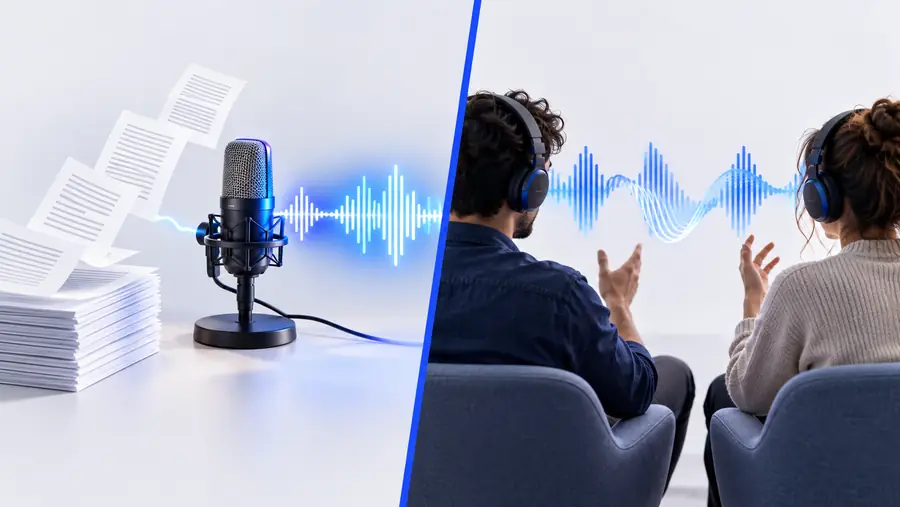
The visual distinction is simple: one path starts with prepared copy and ends with rendered speech; the other keeps context in the loop between input and response.

Context and interaction

Comparison of voice AI and voice generator workflows
AI voice generator producing speech from written text
Script to speech

Use the path that matches your starting input.

At a glance

Three signals that settle the choice

These are not performance claims or product limits. They are practical signals for classifying the job before you test a tool.

A generator is a natural fit when the source is a prepared script.
Text input
Both approaches can involve speech, but their workflow around that speech is different.
Audio output
Voice AI becomes more relevant when each response depends on what was just said.
Context loop
Start with the single outcome that matters most: produce a track or handle an exchange.
One goal

Honest caveats

What this comparison cannot decide for you

Labels alone cannot guarantee quality, suitability, or responsible use. Test the actual material and interaction pattern before committing to a workflow.

It cannot predict voice quality from a label

The terms voice AI and generator describe broad categories, not one fixed sound, language range, or delivery style.

WorkaroundTest a representative script or conversation sample and judge clarity, pronunciation, pacing, and tone for your project.

It cannot replace a rights review

A technically convincing voice does not automatically give you permission to imitate a person, use source recordings, or publish the result.

WorkaroundUse voices and source material you are authorized to use, and document consent where identity or likeness could be involved.

It cannot turn a script into a conversation by itself

A generated recording may sound natural while remaining a fixed performance. It does not automatically understand follow-up questions or changing intent.

WorkaroundAdd an interaction design and response logic when the experience must adapt to what a listener says.

It cannot make the workflow decision without your constraints

A production team may value repeatability, while a support team may value context and turn-taking. There is no universal winner.

WorkaroundWrite down the input, required output, review process, and acceptable level of automation before comparing tools.

Make the next test

Start with the smallest useful voice experiment

Bring one real script or one clearly defined interaction to the next test. If the goal is a finished performance, begin with a generator workflow; if the goal is an adaptive exchange, begin with voice AI. The comparison only becomes useful when it is tied to material your team actually needs to handle.

  • Use a representative sample, not a generic demo
  • Decide whether context must persist between turns
  • Review permissions before publishing or sharing output

Comparison FAQ

Voice AI vs generator questions

These answers clarify the most common point of confusion when the two terms appear in the same project brief.

A voice generator primarily creates spoken audio from an input such as text. Voice AI is a broader category that can include understanding speech, managing context, and producing a response during an interaction.

It can be, depending on how broadly the term voice AI is being used. A generator is usually the narrower production function, while voice AI may describe the complete system around listening, reasoning, responding, and speaking.

Choose a generator when you already have a script and need a controlled spoken performance. Voice AI is more relevant when the narration experience must react to questions, user choices, or changing context.

Neither is automatically better because they optimize for different outcomes. Voice AI is a better fit for adaptive conversations, while a generator is often the clearer fit for repeatable script-to-speech production.

Usually, the script, terminology, and approved voice direction can remain useful, but the interaction layer must be designed separately. Start by identifying which parts of the current workflow are fixed production and which parts need to respond to users.

Try voice tools
Try voice tools